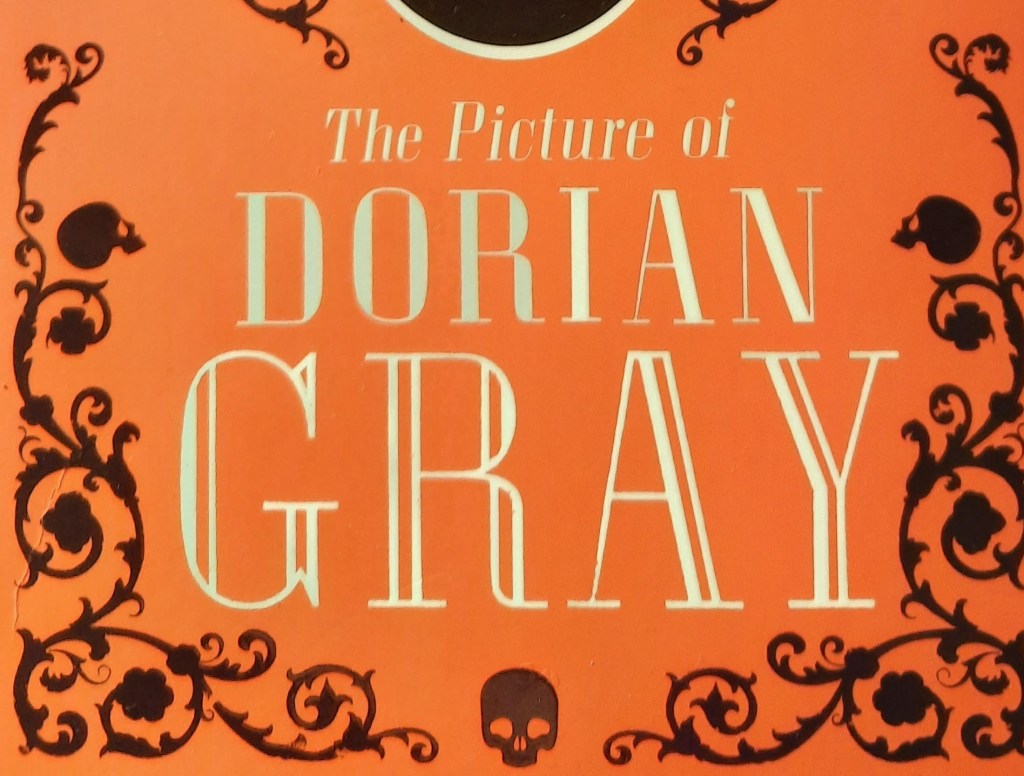
1891 | Oscar Wilde
I’ve been meaning to read The Picture of Dorian Gray for a long time. For years, I’ve heard good things about this book, and I’m never one to turn down a classic. Perhaps this is why, when I finally read it, it was something of a disappointment. It’s not a bad book by any means, and at times Wilde writes something brilliant and very quotable, however, to me, the whole felt slightly thin and overly reliant on telling rather than showing.
The character of Henry Wotton, whose character seems to be mostly dependent on witticism, is the most frequent deliverer of Wilde’s immortal quotes, such as: “I choose my friends for their good looks, my acquaintances for their good character and my enemies for their good intellects.” (p. 11). There are many more, and I would assume there are entire articles written about the strong quotes in these books, many of which showcase the values of the aestheticism movement. I enjoyed this part of the novel, and will carry many of the quotes with me for a long time. It is the story between these quotes, the believability of the characters, and the way it is conveyed to the reader that I at times found lacking.
Wilde’s descriptions are vivid and wonderful, and the London which the characters inhabit feels lived, with both gilded beauty and soot-covered slums. It’s like I’ve visited Dorian’s library and the locked-off schoolroom where he keeps the painting and his conscience. The reader is met by such a florid description even as they enter the painter Basil Hallward’s studio at the start of the novel:
The studio was filled with the rich odour of roses, and when the light summer wind stirred amidst the trees of the garden, there came through the open door the heavy scent of the lilac or the more delicate perfume of the pink-flowering thorn. (p. 5)
These descriptions extend even to the characters’ internal lives and emotions, which robs the reader of the pleasure of learning about them through action, inaction and dialogue. At times, entire pages are filled with these mental struggles, which, while fascinating, slows the plot down to a crawl. Not to mention chapter eleven, where sixteen pages are dedicated to Dorian’s various obsessions, hobbies, and collections during the novel’s major timeskip. While fascinating at first, thanks to Wilde’s prose and description, it felt akin to reading a dictionary towards the end: “[…] such as the olive-green chrysoberyl that turns red by lamplight, the cymophane with its wire-like line of silver, the pistachio-coloured peridot, rose-pink and wine-yellow topazes […]” (p. 124). It goes on like that, with only the themes changing: “He had chasubles, also, of amber-coloured silk, and blue silk and gold brocade, and yellow silk damask and cloth of gold […]” (p. 128).
Then there are the strange behaviors, which I can only assume is a result of the romanticism inherent in The Picture of Dorian Gray. It seems like the characters fling themselves onto furniture at every possible opportunity, which, of course, adds some flair to the movement, but after a while I began to doubt whether the characters knew how to sit like normal people. And, as in many novels from the time period, swooning is still in fashion. While very dramatic, the characters are almost overacting in their roles as people in a novel, perhaps a result of Wilde’s background with writing plays. Dorian falling out of love with the actress Sibyl Vane, is one such moment: “He flung himself down on the sofa and turned away his face. ‘You have killed my love,’ he muttered.” (p. 81). A dramatic moment, acted out fully by Dorian, and while him losing all affection for the woman simply due to one night’s bad acting is an excellent way to show his superficiality and shallowness, this shallowness also deprives Doran’s character of the depth that would have made him a more interesting character to follow.
Dorian Gray is shallow and obsessed with appearance and youth, influenced by Henry Wotton. He is an empty vessel, ready to be filled by Henry’s poisonous influences. Dorian’s eagerness to please and fully devote himself to Henry’s philosophy seems to be his one defining characteristic. This, it seems, is on purpose by Wilde. As Henry himself states, on the effect of influence on another person: “He becomes an echo of someone else’s music, an actor of a part that has not been written for him.” (p. 19). It’s an interesting idea, explored fully throughout the novel. Dorian becomes the person that Henry gives the impression of being, but the reader is never shown who Henry really is, beneath his witty and hedonistic exterior. There are few actions from him, mostly words, and the allure and influence he exerts over the novel’s other characters seem strange when few of them seem to actually agree with the amoral and aesthetic monologues he’s prone to.
I’m glad that I read The Picture of Dorian Gray, even if it wasn’t the book I hoped it would be. The flowery descriptions and the immortal quotes alone give it value, and don’t doubt that I have learned something from them, learning from Wilde’s only novel as Dorian learned from Henry’s monologues. I don’t think the influence is strong enough to transform me into an echo of someone else’s music, but that is probably a good thing. If you’re interested in influential classics, especially ones that were controversial back in the day due to hints at homosexuality, The Picture of Dorian Gray might be for you.
I read the 2014 edition published by Alma Classics. ISBN: 978-1-84749-372-9
 Tim Fahlstedt
Leave a comment