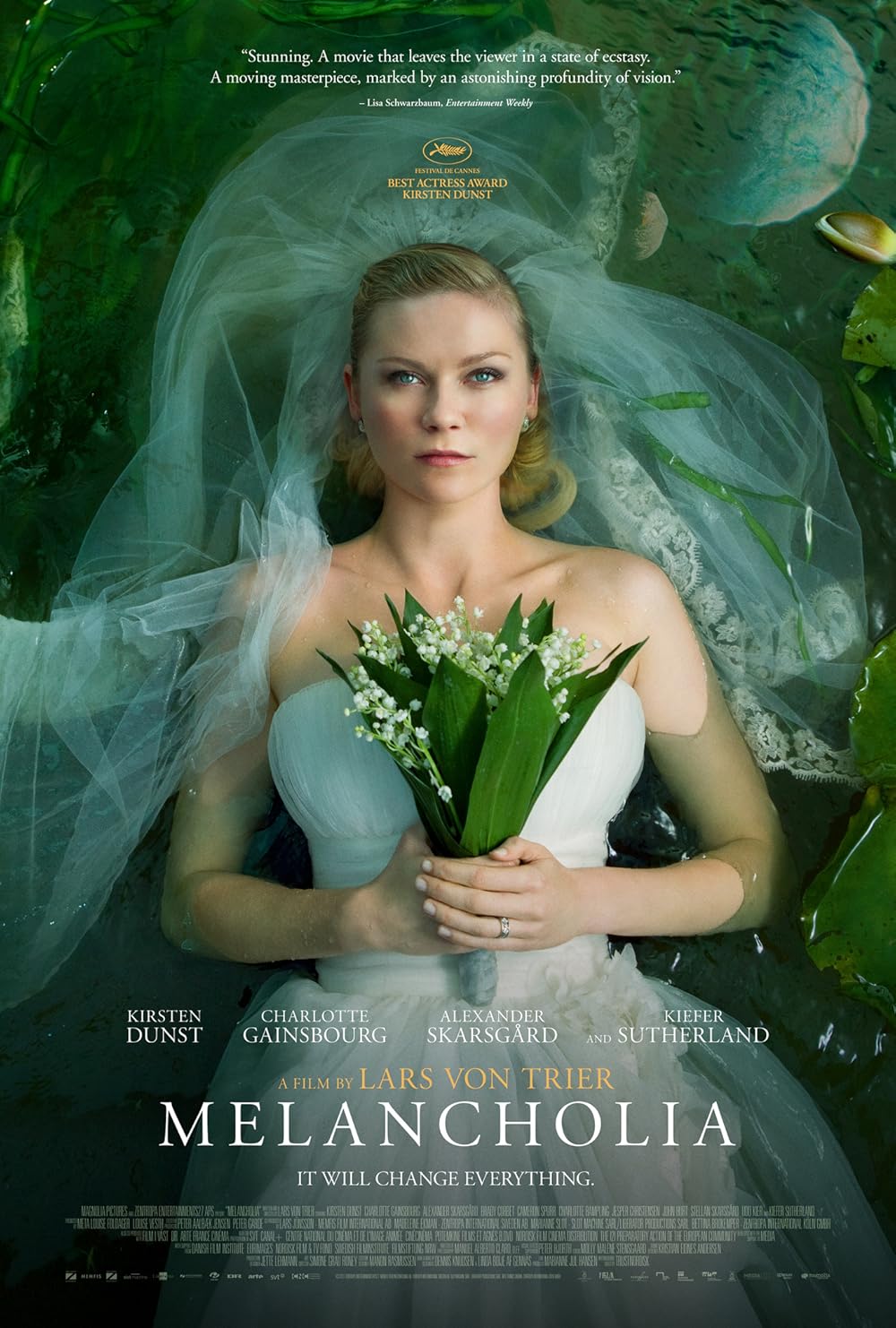
2011 | Directed by Lars von Trier
“The Earth is evil. We don’t need to grieve for it.” – Justine
This film feels like an embodiment of depression, where the melancholy lies heavy over nearly every scene. Divided into two parts, where we first see the slow unravelling of an expensive wedding, and then the impending doom of the planet itself. Both events feel unavoidable, and the characters through which we see these disasters are deeply flawed, plagued by depression, wrong choices, and ruined relationships.
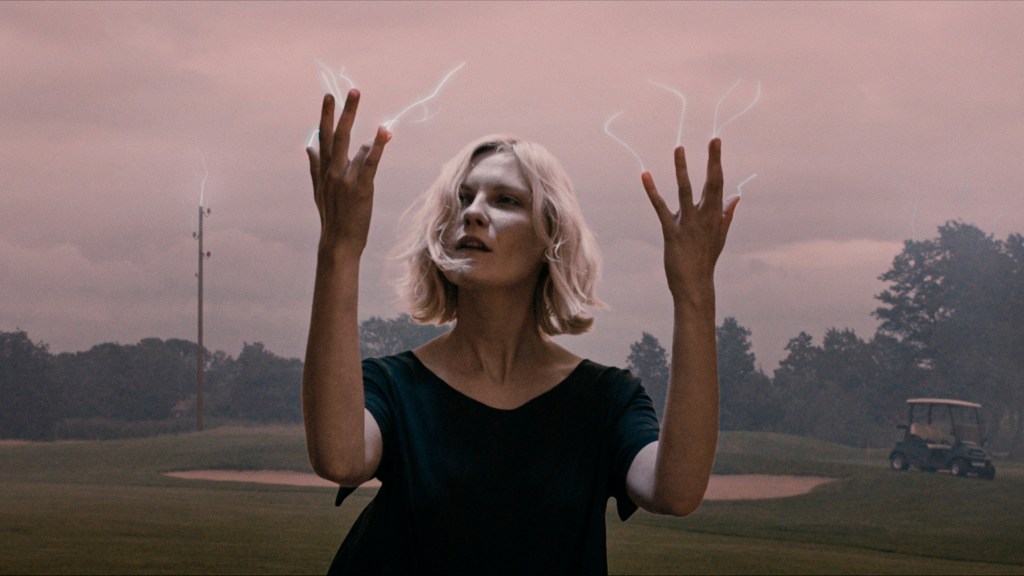
Justine (Kirsten Dunst) tries to escape the reality of her wedding, her work, and her place in the world at every possible opportunity, seeking refuge in the solitude of the empty golf course or in the company of her young nephew. The tragedy of her escape is that the world inevitably pulls her back, no matter what she does. Her sister Claire (Charlotte Gainsbourg), brother-in-law John (Kiefer Sutherland), and manipulative boss Jack (Stellan Skarsgård) all expect things from her. While her newlywed husband, Michael (Alexander Skarsgård), tries his best to ease her back into reality. However, Justine only tries harder to escape, and the harder she tries, the worse the consequences and reality’s terrible gravity.
The characters surrounding Justine all depend on her for their own well-being, and her growing distance from them speeds up their inevitable descent into melancholy and disaster. Claire needs Justine to maintain a façade of normalcy, John wants her to appreciate the luxurious wedding he’s paid for, and Jack depends on her for the tagline for his new marketing campaign. This dependence on Justine is made most obvious through the character of Tim (Brady Corbet), whose lucrative job offer from Jack is tied to getting the tagline from Justine. Then, of course, there’s Michael, whose dream of a life together with Justine slowly but surely falls apart.
It isn’t much of a surprise that Justine escapes her responsibilities and relations like she does, considering how the only people she actively seeks out for support, her parents, turn away from her in their own ways. Anxiety, depression, and fear appear to run in the family, and there’s no escaping them. In the end, you’re alone with your feelings, and when they become too overwhelming, you’re left by the world to drown in them.
The second part of the film, focusing on Claire, feels almost like a relief in contrast to the slow descent into madness of Justine’s wedding. This is the calm before the final storm, with the planet Melancholia slowly heading toward Earth. Here we get to know Claire’s anxiety about the possibility of a collision between Melancholia and Earth, which lingers through everything she does and everything her husband says. Even without the chaos that comes from other people, as seen at Justine’s wedding, her orderly life seems to slowly unravel. She does what she can to keep her mind from anxiety and Melancholia, but in the end, the pull of gravity will decide her fate, no matter what she thinks or feels.
Melancholia, as the name suggests, is not a happy film. It’s a descent into depression, mental illness, and the very real possibility of the world ending. If you’ve experienced mental illness yourself or know someone struggling with it, it will hit even harder. Still, it’s a beautiful film, with powerful performances, picturesque landscapes, and impressive cinematography.
 Tim Fahlstedt
Leave a comment