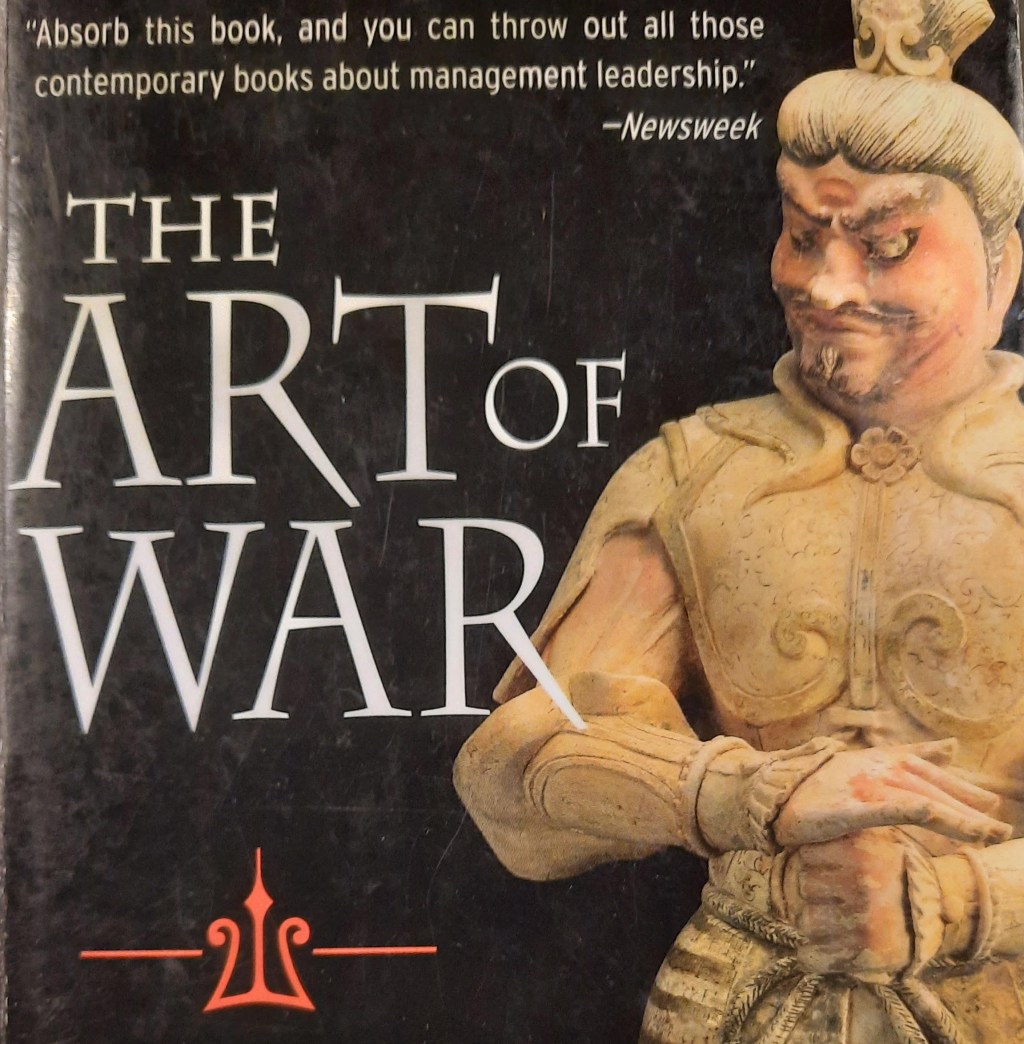
Sun Tzu, English translation by Thomas Cleary
The Art of War is a Chinese classic on warfare and strategy, written over two thousand years ago, that has been celebrated in recent decades as a powerful tool not only on the battlefield, but also in boardrooms and politics. It consists of various bite-sized nuggets of wisdom sorted into thirteen chapters, covering everything from strategic assessments to espionage. The version I read, translated into English by Thomas Cleary, also contains translated comments to the text by eleven Chinese interpreters, the earliest born about two hundred years B.C., and the latest alive during medieval times.
I didn’t know much about it when first picking it up, other than it being an ancient classic, often compared with Machiavelli’s The Prince and other classics often lauded in corporate settings. At first glance, Cleary’s translation showed obvious signs of catering to the aforementioned corporate readers, with quotes praising its importance for executives and the U.S military on the cover. These quotes alone would’ve been enough to scare me away, had it not been for the cultural staying power of this classic, and I must say I was surprised when I opened it and found references to theTao Te Ching and Taoism on the first few pages. I actually read the Tao Te Ching just prior to reading The Art of War, without expecting any clear connection between the two other than both being Chinese classics, and I’m glad I did. The excellent translation of Laozi’s text by Stefan Stenudd gave me a foundational understanding of Taoist philosophy in preparation for Sun Tzu, but also made me slightly wary of Cleary’s choices in translating The Art of War. Cleary mentioning the Tao Te Ching, translated as “The Way and its Power”, made it sound more aggressive than necessary, with the prior knowledge that Tao means the way, Te means virtue, and Ching can be translated as classic. Still, there were a lot of interesting facts and explanations in the quite long introduction, and it definitely prepared me for what was to come in an effective way.
Sun Tzu’s words of wisdom are sometimes clear and concise, dealing with the reality of wars in China at the time and how to tackle them, as his take on using local guides: “Unless you use local guides, you cannot get the advantages of the land” (p. 99). In ancient times, marching an army into foreign land without any locals to guide you through the terrain, with choking points, sources of water, and other important features, would be a fast way to lose a war. The staying power of The Art of War comes from the fact that, if viewed as metaphor, the readers are able to adapt this nugget of wisdom and make it work for their current-day situations. Are you an executive heading to meet with another company? Someone on the inside to provide you with information is an advantage. Are you a politician about to defend a new law? If you knew what the opposition planned to oppose, you could prepare answers to all their opinions in advance. This is the case for the sayings in the book that appear concise, and it is even more so for the more vague ones. The wisdom contained within these ancient pages won’t give you answers that you don’t already hold within you, at best, they’ll help you realize what you already know about your current situation and help you put it into practice, at worst, it’ll give you some insight into what everyone’s talking about when they mention Sun Tzu’s The Art of War.
Pick up The Art of War if you want to know what the fuss is all about, or if you’re interested in filtering your thoughts through the opaque musings of an ancient Chinese warlord, but don’t expect to find keys to hidden paths toward success in it.
To conclude my thoughts on The Art of War, here are a few of Sun Tzu’s sayings that I found helpful, interesting, or relevant to the current geopolitical situation.
Therefore I have heard of military operations that were clumsy but swift, but I have never seen one that was skillful and lasted a long time. It is never beneficial to a nation to have a military operation continue for a long time. (p. 23)
Russia insists on calling its full-scale invasion of Ukraine a “special military operation”, and I suspect Sun Tzu is correct in his assessment that the long-lasting military operation won’t be beneficial to them in the long term.
The rules of the military are five: measurement, assessment, calculation, comparison, and victory. The ground gives rise to measurements, measurements give rise to assessments, assessments give rise to calculations, calculations give rise to comparisons, comparisons give rise to victories. (p. 65)
You start with the facts, the ground, and by measuring, assessing, calculating, and comparing, you can achieve victory. By working with reality, preparing carefully, and acting deliberately, you can achieve things you might not otherwise have thought possible.
So in the case of those who are skilled in attack, their opponents do not know where to defend. In the case of those skilled in defense, their opponents do not know where to attack. (p. 81)
Information is the key here. If you show no weakness, there are no clear openings to attack, and if you seem strong enough, it seems impossible to defend against you. While this is true for contemporary warfare, it is also interesting to consider in relation to cybersecurity, or maybe political debate.
Military formation is like water—the form of water is to avoid the high and to go to the low, the form of a military force is to avoid the full and attack the empty; the flow of water is determined by the earth, the victory of a military force is determined by the opponent. (p. 93)
This advice is clearly influenced by Taoism, and perhaps by the Tao Te Ching, which often uses water as an ideal to strive towards. Here, military formations, like so many other things in life, flow the easiest and most natural path, and this is also where victory is usually to be found.
Therefore if you do not compete for alliances anywhere, do not foster authority anywhere, but just extend your personal influence, threatening opponents, this makes town and country vulnerable. (p. 155)
This piece of advice reminded me of the current-day USA. Longstanding alliances and agreements are falling apart, leaving just influence and threats.
A government should not mobilize an army out of anger, military leaders should not provoke war out of wrath. Act when it is beneficial, desist if it is not. Anger can revert to joy, wrath can revert to delight, but a nation destroyed cannot be restored to existence, and the dead cannot be restored to life. Therefore an enlightened government is careful about this, a good military leadership is alert to this. This is the way to secure a nation and keep the armed forces whole. (p. 163)
One of my favorite quotes from The Art of War. War and conflict are never beneficial to the common people, who are just looking to live their lives in peace. If governments and warlords could desist and focus on prosperity by other means, the world would be a better place.
I read the 2005 edition of Thomas Cleary’s translation, published by Shambhala Publications. ISBN: 978-1-59030-225-5
 Tim Fahlstedt
Leave a comment